
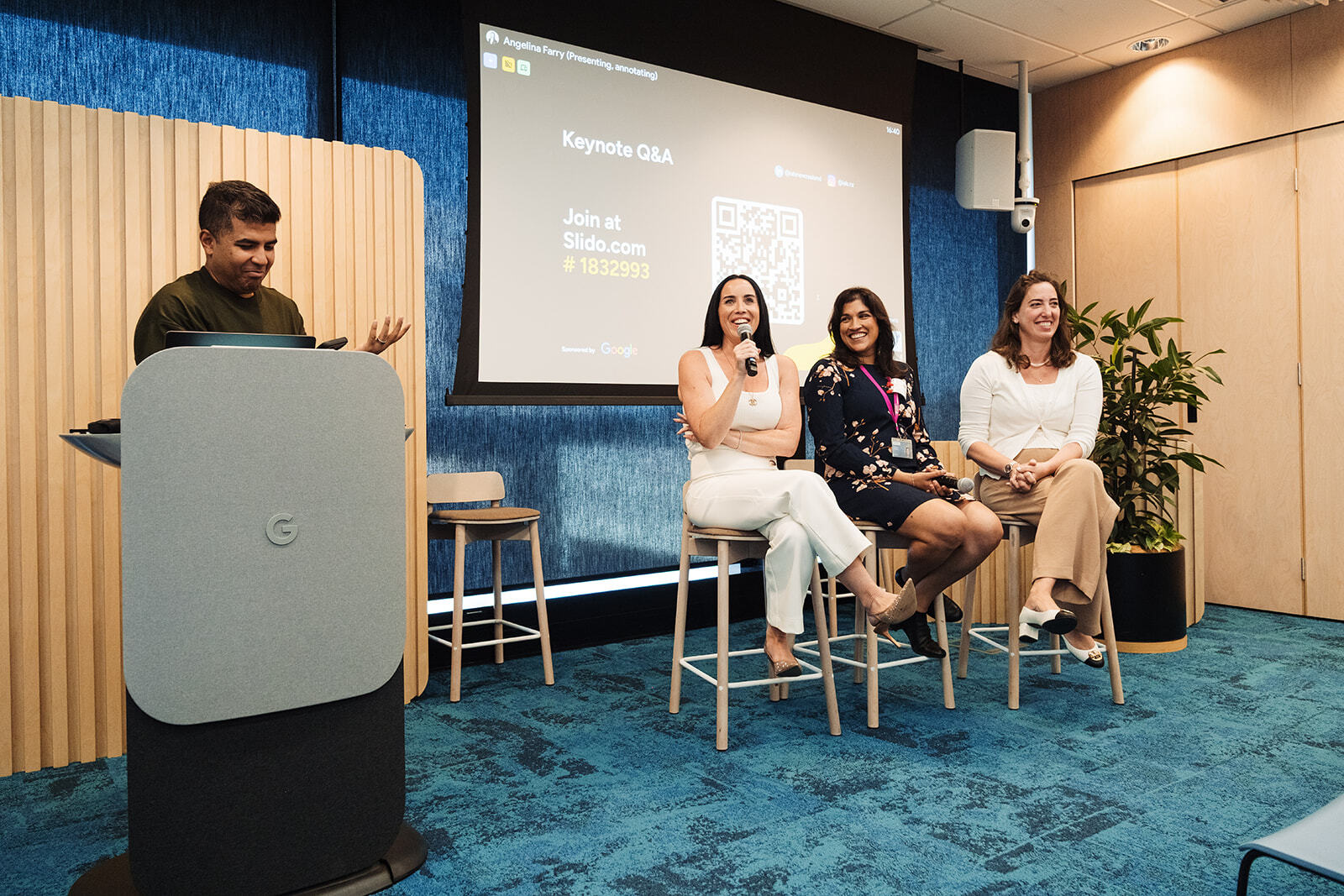
The IAB New Zealand AI Working Group brought together four NZ industry experts together to discuss the future of marketing and AI. AI is moving fast and consumers are already using it to make decisions - we heard about zero-click search, SXO, AEO, and AIO, shifts in measurement, and how to integrate AI tools with the right guardrails around data, privacy, and brand safety. If you missed the event, here are some of the key highlights.
A big thank you to our expert speakers and AI Working Group lead Adnan Khan, Co-Founder Stitch, and Stitch Predict.
🎤 Natalie de Boursac, Government & Retail Specialist, Google Cloud, Google
🎤 Sophie Neate, Global Head of Digital Marketing & Content, ABB
🎤 Dr. Shahper Richter, Senior Lecturer Digital Marketing, University of Auckland
Here are some of the key messages from the event, plus a few more helpful resources: We've developed a NotebookLM outtakes podcast, you can download keynote speaker resources below and you can check out some of the event Q&As.
📚 Governance is key. Feeling prepared is not the same as being prepared. Dr. Shahper Richter Senior Lecturer Digital University of Auckland shared a striking gap: 90% of organisations feel prepared for AI, yet 70% are already reporting AI incidents, and less than 35% are increasing governance investment. That's not a governance problem - it's optimism bias.
🙋♀️ The B2B buyer has already changed. Sophie Neate Global Head of Digital Marketing & Content ABB said the shift from SEO to SXO isn't on the horizon - it's here. With Millennials and Gen Z now making up 71% of B2B buyers and set to dominate buying centres by 2030, the entire search experience needs to evolve now.
🤖 Agentic Commerce is speeding up the consumer discovery and purchase journey. Natalie de Boursac Government & Retail Specialist Google Cloud explained how AI is moving from answering queries to anticipating needs, reasoning through options, and completing transactions, with real-world results already showing up in basket size growth 🛒
🎧 Listen to some of the event highlights in the 20 minute IAB NZ Insights Podcast thanks to the power of NotebookLM and AI.
Download Natalie de Boursac from Google's Agentic Commerce Quick Start Guide.

Download Dr. Shahper Richter's Keynote Presentation.

Check out the full event photo gallery here, and see if you can spot yourself or a friend 📸
Plus, if you had a burning question that didn't get covered off on the day, check out the below for some additional Q&As:
Q: In terms of AI governance, is there guidance on best practices for informing customers about AI usage, such as badging on AI creative?
A: Dr. Shahper Richter, Senior Lecturer Digital Marketing, University of Auckland
In New Zealand, there is no mandatory requirement to label or badge AI-generated content, but the government's Responsible AI Guidance for Businesses (MBIE, 2025) explicitly recommends it as best practice. The guidance advises that labelling AI-generated content or providing disclaimers about AI use supports transparency and helps customers identify when GenAI has been used and notes that AI watermarking is an emerging tool for authenticating AI-generated images more robustly. This sits within a broader principle that businesses should proactively inform customers when and where GenAI is being used, for example in chatbots or customer-facing tools. The legal backstop is the Fair Trading Act 1986, which prohibits misleading conduct, meaning that presenting AI-generated content as human-created could carry regulatory risk even without AI-specific rules. New Zealand's overall approach is principles-based and light-touch, preferring guidance over legislation, so compliance is currently voluntary but directionally clear. For the full guidance document: https://www.mbie.govt.nz/assets/responsible-ai-guidance-for-businesses.pdf
Q: What is the 'AI Marketing Model' you're working on building at ABB? What are the use cases?
A: Sophie Neate, Global Head of Digital Marketing & Content, ABB
The AI marketing model for ABB is initially focused on enabling Account-Based Marketing (ABM) at scale. Operating in a global environment means traditional 1:1 or 1:few ABM approaches are often not practical. Instead, we must engage multiple customers within the same industry who share similar challenges, delivering relevant and scalable solutions.
AI will help automate many of the more time-consuming operational activities through agentic capabilities, allowing our teams to focus more on strategy and initiatives that drive maximum ROI. For example, lead scoring plays a critical role in identifying when an account progresses from a Marketing Qualified Account (MQA) to a Sales Qualified Account (SQA). This insight is essential for determining the appropriate level of targeting and engagement. Through predictive analytics, the AI marketing model will strengthen this process and provide more accurate qualification signals.
Additionally, our lead management process will be significantly enhanced through AI. Today, response times can take up to three days; with AI-enabled workflows, we aim to reduce this to one day, while also removing the dependency on manual processes for assigning leads accurately and efficiently.
To support this, we will leverage our existing marketing technology stack and ultimately integrate a Customer Data Platform (CDP) to centralize data filtering and segmentation. This will allow us to manage audience insights more effectively and optimize our marketing operations at scale.
These are just a few examples of the opportunities ahead. We are structuring our implementation in phased waves, ensuring we address immediate priorities first while also building toward our long-term objectives, positioning us for sustained success in the future.
Q: Big Corporates are going hard on cost cutting and lay offs. But humans are the core of the transformation…what are your thoughts?
A: Sophie Neate, Global Head of Digital Marketing & Content, ABB
Not necessarily. Humans are not becoming less important in this transformation, in many ways, we’re becoming more strategically important. Yes, big corporations are aggressively cutting costs and restructuring, but that doesn’t necessarily mean humans are being pushed aside. What’s really happening is a shift in how human talent is used.
Routine, repetitive, and easily automated work is increasingly handled by technology. That frees people to move into higher-value strategic roles, creativity, problem-solving, relationship building, leadership, and innovation. Those are areas where humans still outperform machines.
So, the layoffs and cost cutting we’re seeing often reflect organizational realignment, not the disappearance of human value. Companies are trying to become leaner operationally while investing more in human capabilities that drive transformation, strategy, design, customer insight, ethics, and complex decision-making.
In other words, humans are becoming the architects of the transformation rather than the operators of the old systems.
The companies that succeed long-term will be the ones that combine technology efficiency with human ingenuity, not replace one with the other. And this is exactly what ABB are doing.
Q: ABB - you spoke about creating website content optimised for AI with the likes of bullet points and FAQs. How do you create content balanced for AI and humans?
A: Sophie Neate, Global Head of Digital Marketing & Content, ABB
Creating content that works for both AI and humans is less about choosing one over the other and more about clarity and structure. The things that help AI understand content, clear headings, bullet points, concise explanations, and FAQs, also tend to make content easier and faster for humans to read.
A good approach is to start by writing for the human reader: focus on clear messaging, useful information, and real value. Then structure it in a way that makes it easy to scan and understand. That’s where elements like bullet points, short sections, and FAQ-style answers come in. These formats help AI systems extract meaning while also improving readability for people.
In many ways, optimising for AI is encouraging us to create better, more organized content overall. It pushes us toward being more transparent, direct, and helpful, which ultimately benefits both search systems and human audiences.
So rather than a trade-off, it’s really an alignment: when content is clear, structured, and genuinely useful, it performs well for both AI and humans.
Ends.
Thank you go our event sponsor:





.svg "MPI-logo-colour-keyline-white-text (2)")