
It was great to see so many familiar faces from the IAB New Zealand community at the recent Agentic Retail Summit, including members like Spark and The Warehouse Group, who are already deep into their own AI journeys. It was a good reminder that the conversations happening in our industry aren't happening in isolation, and that retail and media are dealing with a lot of the same questions when it comes to AI. Alex Lawson, Principal, The Media Practice attended the summit and shares his perspective.
.png?width=200&height=200&name=Untitled%20design%20(70).png) Author: Alex Lawson, Principal, The Media Practice
Author: Alex Lawson, Principal, The Media Practice
Is the New Zealand marketing industry leading, keeping pace, or lagging when it comes to AI adoption? That question was front of mind at the recent Agentic Retail Summit, hosted by Juanita Neville Te Rito's The RX Group.
AI in advertising has always attracted a mix of excitement, hype and fear-mongering, and it's not always easy to tell them apart. Marketers like to think of themselves as early adopters so basic productivity tasks such as writing, editing and platform optimisation are now widely accepted as standard practice, and data categorisation and measurement are equally well established. Content creation remains more contentious, splitting opinion depending on where you sit in the industry, but it's a debate that will only grow more mainstream as more New Zealand examples of AI generated content appear.
Retail, meanwhile, is working hard to keep pace with its own version of this shift. Like media, it's an industry that has weathered plenty of "death of" predictions over the years, and the rise of agentic commerce agents is only adding to that pressure. So what are retail's AI pioneers actually telling us, and what can the advertising industry take from it?
AI is already deeply embedded in retail strategy
Retailers are a bit like swans. What looks calm and controlled on the surface, whether that's an in store experience or a slick website, often masks a lot of activity happening beneath it. Much of that activity is AI driven, sitting in places customers rarely see: supply chain, warehousing, merchandising and beyond.
Retailers have been building AI strategies, and learning from the inevitable setbacks, for longer than most people realise.
At the Summit, Ankit Gupta, Group Chief Data and AI Officer at The Warehouse Group, and Mandy Tomlinson, General Manager of Consumer Channels at Spark, spoke about their enterprise AI journeys.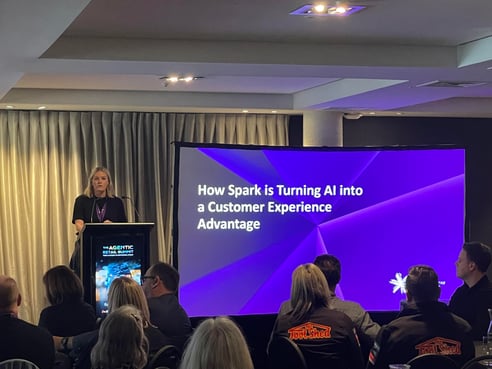 What stood out was how much emphasis both put on governance and stakeholder management, alongside the technology itself. Both organisations are enthusiastic about AI's potential across the business, but getting the foundations right from day one matters enormously when you're operating at that scale.
Backend first, flashy stuff second
Much like media's own AI journey, which began with optimisation and workflow tools before moving into generative content, retail's adoption has started well away from the shop floor, in distribution centres, shipping and forward planning. Aiden Bartlett from Designer Wardrobe shared how AI now helps their resellers batch upload listings straight from photos, automatically setting pricing and writing product descriptions. That shaved hours off their days and freed sellers up to focus on selling, packing and shipping.
Petdirect's Head of Retail, Aaron Waters, and Head of Marketing, Taylor Jones, shared a candid look at their own AI journey, in a business led by a genuinely tech obsessed team already operating at the sharp end of ecommerce and subscription retail. Their ‘test, learn, fail fast or lean in to’ a wide range of AI tools is a blueprint not unlike what we have seen in advertising.
Data cleansing and organisation came up repeatedly. Many retailers are sitting on huge volumes of first party data, and how that data is sorted and made usable is often the real challenge. AI is proving to be a valuable partner here, significantly cutting the resource hours and timeframes needed - a benefit that applies just as much to media as it does to retail.
AI plus humans, not AI instead of humans
This theme echoed across both retail and marketing conversations at the Summit. Some roles will inevitably shift or disappear, and many of us will need to rethink how we work, but that's not a new story. After all, there's less demand for farriers now that most of us drive cars - industries evolve, and people adapt.
For anyone wanting to see AI in action across multiple sectors, not just retail, it's hard to go past Simon Conroy and Adam Holt from thecolab.ai. Adam is regarded as one of the world's leading Claude engineers and runs monthly Anthropic meetups across several New Zealand cities, though be warned, spots fill fast. Simon walked the room through Consumerlytics, a customer sentiment platform that scrapes brand and product mentions to build a live dashboard tracking sentiment against competitors, essentially social listening taken to another level.
In a similar space, Lokal, an Australian platform built by former oOh!media exec Neil Ackland, is also worth watching. It scrapes sentiment from product reviews, influencers and everyday customers, then surfaces genuine recommendations directly on product pages, matched to the person viewing them. Both platforms share a common goal: surfacing real human sentiment while steering clear of the fake chatter that can push people toward decisions based on bad data.
This summit certainly proved that AI was alive and well in the retail industry, and there are plenty of lessons we can take into our own AI experimentation and implementation.
So, where does that leave me on the panic versus hype scale? Somewhere closer to hype than panic, but with a healthy dose of realism. AI is a genuinely powerful tool for marketing, and retail's experience offers a useful blueprint. But as with any tool, it needs thought, testing and proper guardrails to deliver real value.










Comments